Frequently asked questions
I adopted a dog at the shelter and was told that he is a Staffordshire Terrier. Is a Staffordshire Terrier the same as a Pit Bull?
First, it is important to know that Staffordshire Terrier and “Pit Bull” are not official breeds, but rather common terms used to describe a certain type of dog. There are actually many dog breeds that can be easily confused and are often mistakenly referred to as Pit Bulls. The correct designations are:
How can we tell the difference? We can't, really. We can only try to guess the breed based on subtle characteristics. Note that even experts can't always tell if a Pit Bull is an APBT, an AST or a SBT. Even with DNA testing, many known purebred dogs come up with results of mixed breed lineage. For the average Pit Bull owner, however, these distinctions are not really relevant. As a general rule, dogs of these breeds tend to have stable and loving temperaments.
The American Pit Bull Terrier (APBT)
Like many other common breeds, including Labrador Retrievers, Greyhounds, German Shepherds, and the Parsons (or “Jack”) Russell Terrier, the American Pit Bull Terrier is essentially a canine athlete. As the UKC points out, during the nineteenth century breeders in the British Isles began to experiment with crosses between terriers and Bulldogs in hopes of finding a dog with the “gameness” of a terrier and the athleticism of a Bulldog (a very different dog from the English Bulldog of today). This original breed, which later resulted in the breeds we now call the American Pit Bull Terrier, the American Staffordshire Terrier, and the Staffordshire Bull Terrier, came to America with immigrants during the late nineteenth century. Just as the Bulldog was originally bred for bull and bear baiting, dog fighting was part of the APBT’s original purpose. But as the UKC also notes, the breed’s many talents did not go unnoticed, and the APBT was also used as an all-purpose farm dog and family companion.
Today, the APBT is bred for a wide variety of purposes, so it is difficult to make generalizations about appearance or purpose. While some APBTs may be directly from fighting lines (“game bred”), many are genetically far removed from their fighting ancestors. Aggression or reactivity toward other dogs or animals can range from non-existent to very high to somewhere in between. For more information please see Pit Bulls and Other Dogs.
While aggression toward other dogs can be relatively common among Pit Bulls, aggression toward humans has never been a normal trait among these breeds. Pit bulls were not bred to be aggressive towards humans or for guarding purposes. This is one reason why they score so highly in tests such as the American Temperament Test Society’s standardized temperament test: American Temperament Test Society
An often-overlooked fact of the APBT’s history is that human aggressive dogs have been actively culled from bloodlines. In the world of fighting, it is not useful or desirable for a dog to attack handlers or spectators. Not all APBT breeders breed for the pit, though. Many breed for conformation, temperament, weight-pulling, obedience trials, or therapy work. Regardless of their purpose, APBTs share the same physical and mental characteristics of a lean and athletic body, agility, courage, and stable personality.
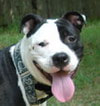
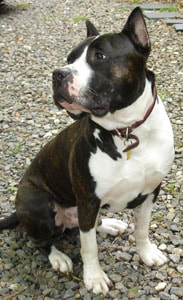
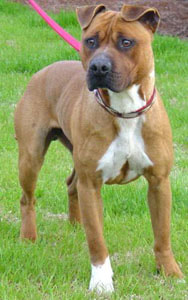
Because breeding purpose varies so widely among APBTs, less consideration is paid to conformation (how closely the dog matches a set physical standard for the breed). As these pictures show, APBTs can look quite different from one another. In general, however, APBTs can weigh as little as 30 lbs. and as much as 70 lbs. News reports of “Pit Bulls” weighing in excess of 100 lbs. should be taken with a grain of salt. These dogs are either not Pit Bulls at all or are mixes of some sort.
First, it is important to know that Staffordshire Terrier and “Pit Bull” are not official breeds, but rather common terms used to describe a certain type of dog. There are actually many dog breeds that can be easily confused and are often mistakenly referred to as Pit Bulls. The correct designations are:
- American Pit Bull Terrier (APBT) - recognized by the ADBA (American Dog Breeder’s Association) and UKC (United Kennel Club)
- American Staffordshire Terrier (AST) - recognized by the AKC (American Kennel Club)
- Staffordshire Bull Terrier (SBT) - recognized by the AKC and UKC
How can we tell the difference? We can't, really. We can only try to guess the breed based on subtle characteristics. Note that even experts can't always tell if a Pit Bull is an APBT, an AST or a SBT. Even with DNA testing, many known purebred dogs come up with results of mixed breed lineage. For the average Pit Bull owner, however, these distinctions are not really relevant. As a general rule, dogs of these breeds tend to have stable and loving temperaments.
The American Pit Bull Terrier (APBT)
Like many other common breeds, including Labrador Retrievers, Greyhounds, German Shepherds, and the Parsons (or “Jack”) Russell Terrier, the American Pit Bull Terrier is essentially a canine athlete. As the UKC points out, during the nineteenth century breeders in the British Isles began to experiment with crosses between terriers and Bulldogs in hopes of finding a dog with the “gameness” of a terrier and the athleticism of a Bulldog (a very different dog from the English Bulldog of today). This original breed, which later resulted in the breeds we now call the American Pit Bull Terrier, the American Staffordshire Terrier, and the Staffordshire Bull Terrier, came to America with immigrants during the late nineteenth century. Just as the Bulldog was originally bred for bull and bear baiting, dog fighting was part of the APBT’s original purpose. But as the UKC also notes, the breed’s many talents did not go unnoticed, and the APBT was also used as an all-purpose farm dog and family companion.
Today, the APBT is bred for a wide variety of purposes, so it is difficult to make generalizations about appearance or purpose. While some APBTs may be directly from fighting lines (“game bred”), many are genetically far removed from their fighting ancestors. Aggression or reactivity toward other dogs or animals can range from non-existent to very high to somewhere in between. For more information please see Pit Bulls and Other Dogs.
While aggression toward other dogs can be relatively common among Pit Bulls, aggression toward humans has never been a normal trait among these breeds. Pit bulls were not bred to be aggressive towards humans or for guarding purposes. This is one reason why they score so highly in tests such as the American Temperament Test Society’s standardized temperament test: American Temperament Test Society
An often-overlooked fact of the APBT’s history is that human aggressive dogs have been actively culled from bloodlines. In the world of fighting, it is not useful or desirable for a dog to attack handlers or spectators. Not all APBT breeders breed for the pit, though. Many breed for conformation, temperament, weight-pulling, obedience trials, or therapy work. Regardless of their purpose, APBTs share the same physical and mental characteristics of a lean and athletic body, agility, courage, and stable personality.
Because breeding purpose varies so widely among APBTs, less consideration is paid to conformation (how closely the dog matches a set physical standard for the breed). As these pictures show, APBTs can look quite different from one another. In general, however, APBTs can weigh as little as 30 lbs. and as much as 70 lbs. News reports of “Pit Bulls” weighing in excess of 100 lbs. should be taken with a grain of salt. These dogs are either not Pit Bulls at all or are mixes of some sort.
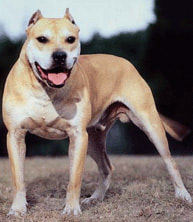

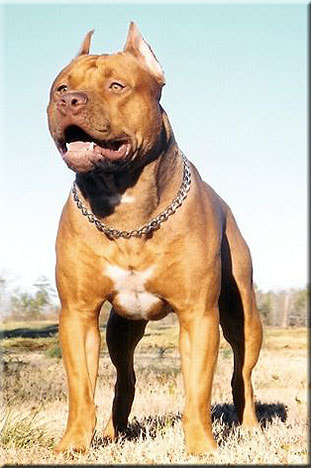
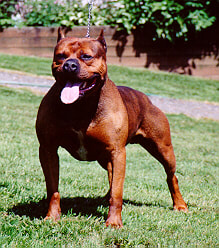
Show and Confirmation American Pit Bull Terrier - APBT
Nowadays people without breeding knowledge are breeding Pit Bulls for unusual color (typically tri-color, blue or merle), general companionship, or to make a quick buck. The animal-welfare community refers to these people as “backyard breeders.” In general, their dogs are a little larger than the original APBT. Backyard breeders of any breed are a major contributor to America’s pet overpopulation problem. These are the dogs that most commonly wind up in shelters or rescues.
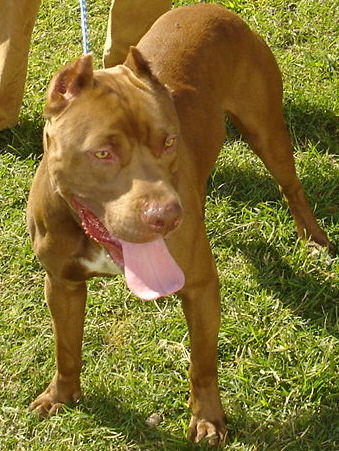
Backyard Breed American Pit Bull Terrier - APBT
The American Staffordshire Terrier (AST or Amstaff)
The AST or “Amstaff” used to be the same dog as the APBT but was completely taken out of the pit in the mid 1930s. In 1936, the AKC opened its studbooks to a few APBTs that fit their standards and came up with the name “Staffordshire Terrier.” In 1972, the name was changed to American Staffordshire Terrier to avoid confusion with the newly recognized “Staffordshire Bull Terrier” from England. The only dogs that can properly be called American Staffordshire Terriers are those from AKC-registered bloodlines.
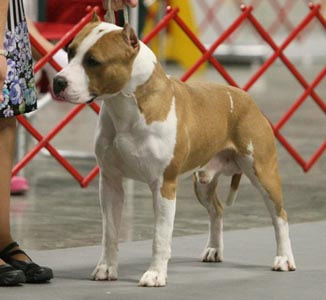
ASTs are primarily bred for conformation and good temperament. They have a set height standard of 18 to 19 inches for males and 17 to 18 inches for females. They usually weigh between 50 to 80 lbs., which should be in proportion to their height. They may be a little stockier than the APBT but not always. “The dog’s chief requisites,” the AKC explains, “should be strength unusual for his size, soundness, balance, a strong powerful head, a well-muscled body, and courage that is proverbial.”
Red (or “Dudley”) noses are considered a fault according to the AKC’s breed standard, and this physical trait has been bred out of most AST lines. Red-nosed dogs are common in APBT lines. This may help you differentiate between the breeds. If the dog has a red nose, it is more likely to be of APBT than of AST lineage.
The AST or “Amstaff” used to be the same dog as the APBT but was completely taken out of the pit in the mid 1930s. In 1936, the AKC opened its studbooks to a few APBTs that fit their standards and came up with the name “Staffordshire Terrier.” In 1972, the name was changed to American Staffordshire Terrier to avoid confusion with the newly recognized “Staffordshire Bull Terrier” from England. The only dogs that can properly be called American Staffordshire Terriers are those from AKC-registered bloodlines.
ASTs are primarily bred for conformation and good temperament. They have a set height standard of 18 to 19 inches for males and 17 to 18 inches for females. They usually weigh between 50 to 80 lbs., which should be in proportion to their height. They may be a little stockier than the APBT but not always. “The dog’s chief requisites,” the AKC explains, “should be strength unusual for his size, soundness, balance, a strong powerful head, a well-muscled body, and courage that is proverbial.”
Red (or “Dudley”) noses are considered a fault according to the AKC’s breed standard, and this physical trait has been bred out of most AST lines. Red-nosed dogs are common in APBT lines. This may help you differentiate between the breeds. If the dog has a red nose, it is more likely to be of APBT than of AST lineage.
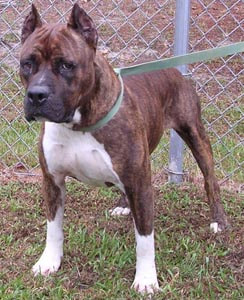
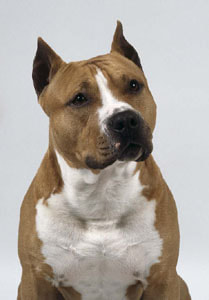
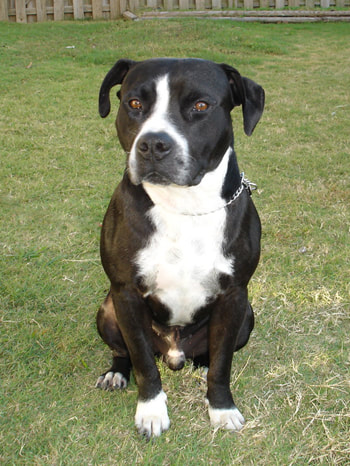
American Staffordshire Terrier
Because the AST and APBT have the same ancestors (some are even dual-registered), they have a similar look and similar personalities.
Staffordshire Bull Terrier (SBT, Staffie or Stafford)
Staffies remain very popular in England, but they are less common in the United States. They share common ancestors with the APBT and AST, therefore exhibit many of the same breed traits. Staffordshire Bull Terriers should be 14-16" at the shoulder height and at 24 to 34 lbs., they are noticeably smaller, though, and their ears are rarely cropped. They are essentially bred for good disposition and conformation. The AKC points to the Staffie Bull’s “affection for its friends” as well as “off-duty quietness” and “trustworthy stability,” all of which make it “a foremost all-purpose dog.” They are often referred to as “nanny dogs” because they are excellent with children. Typically, dogs labeled in a shelter as a SBT are wrongly labeled as such.
Staffordshire Bull Terrier (SBT, Staffie or Stafford)
Staffies remain very popular in England, but they are less common in the United States. They share common ancestors with the APBT and AST, therefore exhibit many of the same breed traits. Staffordshire Bull Terriers should be 14-16" at the shoulder height and at 24 to 34 lbs., they are noticeably smaller, though, and their ears are rarely cropped. They are essentially bred for good disposition and conformation. The AKC points to the Staffie Bull’s “affection for its friends” as well as “off-duty quietness” and “trustworthy stability,” all of which make it “a foremost all-purpose dog.” They are often referred to as “nanny dogs” because they are excellent with children. Typically, dogs labeled in a shelter as a SBT are wrongly labeled as such.
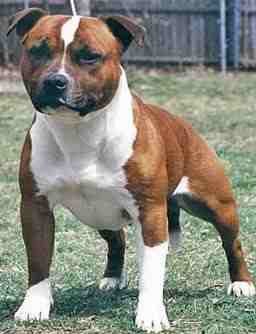
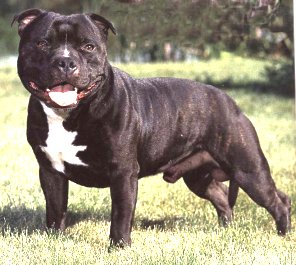
Staffordshire Bull Terrier
American Bully
The American Bully was recognized as a breed by the United Kennel Club (UKC) in the summer of 2013. It first appeared in the 1990s and was created by crossing American Pit Bull Terriers, American Staffordshire Terriers, and other breeds. According to the UKC: “The American Bully breed was subtly influenced by the infusion of several other breeds, which include the American Bulldog, English Bulldog, and Olde English Bulldogge.” American Bullies vary in looks, but all share the same bullfrog-like appearance. While the American Bully certainly looks tough, it is a conformationally exaggerated dog with emphasis on extremes: wide, short, jowly and slow-moving. They are not as athletic as their bully breed relatives and may suffer from crippling health problems as they age like English Bulldogs and other breeds bred for a certain look. According to American Bully breeders, gameness and dog-aggression have been bred out, thereby, creating a dog highlighting the characteristics of loyalty and stability with people. Advocates of the breed would like to see the “Pit Bull” label removed from their dogs in favor of “Bulldog”
The American Bully was recognized as a breed by the United Kennel Club (UKC) in the summer of 2013. It first appeared in the 1990s and was created by crossing American Pit Bull Terriers, American Staffordshire Terriers, and other breeds. According to the UKC: “The American Bully breed was subtly influenced by the infusion of several other breeds, which include the American Bulldog, English Bulldog, and Olde English Bulldogge.” American Bullies vary in looks, but all share the same bullfrog-like appearance. While the American Bully certainly looks tough, it is a conformationally exaggerated dog with emphasis on extremes: wide, short, jowly and slow-moving. They are not as athletic as their bully breed relatives and may suffer from crippling health problems as they age like English Bulldogs and other breeds bred for a certain look. According to American Bully breeders, gameness and dog-aggression have been bred out, thereby, creating a dog highlighting the characteristics of loyalty and stability with people. Advocates of the breed would like to see the “Pit Bull” label removed from their dogs in favor of “Bulldog”
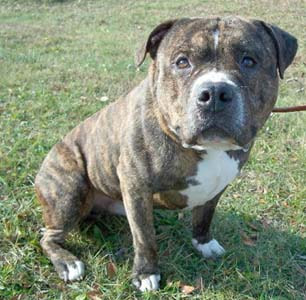
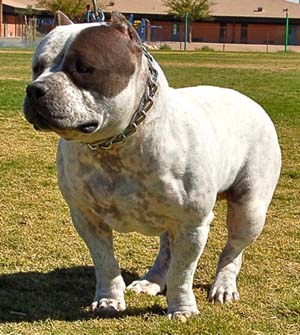
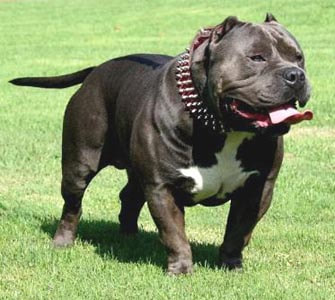
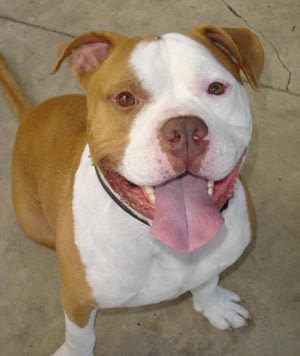
American Bully
What is gameness? Is this a negative trait?
NOTE: Most importantly, gameness is not aggressiveness. It has nothing to do with aggression (toward animals or humans) and should not enter into discussions about overall temperament. Gameness is working drive. Very simply put, gameness is the will never to quit a task despite injury, illness, or exhaustion. When other dogs throw in the towel, a Pit Bull will continue on. It is the unflagging courage referred to in UKC and AKC descriptions of these breeds. Gameness is only a negative trait when exploited, such as in dog fighting. It is a trait that makes responsible owners proud when used positively, such as: flyball, disc dogs, scent work, obedience trials.
Like the AKC, we do not discuss gameness and fighting here either to praise or malign Pit Bulls. Fighting and gameness are important elements of the breeds’ history and, ultimately, a key to understanding our dogs. There is nothing admirable, heroic, or particularly interesting about the fighting aspect of Pit Bulls’ history.
Gameness does not equal aggressiveness. A dog can be game without being aggressive and vice versa. Unstable, highly aggressive dogs are, in fact, not at all likely to be game. As Diane Jessup explains in The Working Pit Bull, “Gameness does not mean a desire to fight — it means a desire to finish or succeed at a task” (156). Not all Pit Bulls are game. Dogfighters assess gameness by testing their dogs in the pit, with the ultimate (and very cruel) goal to produce a dog that would fight other dogs to the death (these rare dogs are referred to as “dead game”). But as Jessup further notes, there are other, far better ways to gauge gameness in Pit Bulls and other breeds:
“A few examples of true gameness in a dog would be the weight-pull dog that simply never quits trying to pull a load, and must be stopped by his handler when the load becomes too heavy, the tracking dog who continues to work out a faint, hours-old trail in the 100 degree F heat and scores a perfect 100 in a grueling F.H. German tracking test, […] the search and rescue dog who climbs over brush and debris hour after hour searching for victims. All these are tests of gameness with value (unlike dog fighting, which has no value to society whatsoever) and acceptance in our modern world.” (158)
As the previous passage suggests, gameness is by no means a specialized “Pit Bull trait.” Like aggression toward other animals, it’s a dog trait. This kind of drive is, most accurately, a working dog trait. The tireless Border Collies we see in herding and tracking exhibit gameness. As such, many other breeds are frequently tested and certified for gameness using non-fighting scenarios. The working terriers informally know as “dirt dogs” — a designation that covers Dachshunds, Jack Russell Terriers, Patterdale Terriers, West Highland White Terriers, Cairn Terriers, Norwich Terriers, and many other breeds — are routinely tested on their ability to quarry and “work” small rodents. Jack Russell and Patterdale Terriers still serve the valuable function of ridding farms of groundhogs and badgers.
Because of their focus and determination, Pit Bulls have proven to be excellent candidates for search-and-rescue work and therapy work.
Finally, it is important to recognize that this heritage of gameness partially contributes to the Pit Bull’s wonderful and resilient personality. It is why these dogs possess a constant desire to please and why they readily take up new lives as loving family pets following neglect and abuse. With this in mind, we will give the final word on gameness to Dr. D. Caroline Coile, author of Pit Bulls for Dummies:
“Gameness, though hard to define, is in essence the quality of pressing on cheerfully and with gusto in the face of adversity. In everyday life, this spirit expresses itself in self-confidence, determination, and a certain joie de vivre. […] Gameness is not aggressiveness. A non-aggressive dog can be game (for example, he avoids a fight but does not back down if pressed), and an aggressive dog can be ungame (for example, if he starts a fight but turns tail if the victim fights back). Some Pit Bulls are aggressive with other dogs. Others are not. But as a rule, Pit Bulls were not bred to be aggressive — they were bred to win.”
Like the AKC, we do not discuss gameness and fighting here either to praise or malign Pit Bulls. Fighting and gameness are important elements of the breeds’ history and, ultimately, a key to understanding our dogs. There is nothing admirable, heroic, or particularly interesting about the fighting aspect of Pit Bulls’ history.
Gameness does not equal aggressiveness. A dog can be game without being aggressive and vice versa. Unstable, highly aggressive dogs are, in fact, not at all likely to be game. As Diane Jessup explains in The Working Pit Bull, “Gameness does not mean a desire to fight — it means a desire to finish or succeed at a task” (156). Not all Pit Bulls are game. Dogfighters assess gameness by testing their dogs in the pit, with the ultimate (and very cruel) goal to produce a dog that would fight other dogs to the death (these rare dogs are referred to as “dead game”). But as Jessup further notes, there are other, far better ways to gauge gameness in Pit Bulls and other breeds:
“A few examples of true gameness in a dog would be the weight-pull dog that simply never quits trying to pull a load, and must be stopped by his handler when the load becomes too heavy, the tracking dog who continues to work out a faint, hours-old trail in the 100 degree F heat and scores a perfect 100 in a grueling F.H. German tracking test, […] the search and rescue dog who climbs over brush and debris hour after hour searching for victims. All these are tests of gameness with value (unlike dog fighting, which has no value to society whatsoever) and acceptance in our modern world.” (158)
As the previous passage suggests, gameness is by no means a specialized “Pit Bull trait.” Like aggression toward other animals, it’s a dog trait. This kind of drive is, most accurately, a working dog trait. The tireless Border Collies we see in herding and tracking exhibit gameness. As such, many other breeds are frequently tested and certified for gameness using non-fighting scenarios. The working terriers informally know as “dirt dogs” — a designation that covers Dachshunds, Jack Russell Terriers, Patterdale Terriers, West Highland White Terriers, Cairn Terriers, Norwich Terriers, and many other breeds — are routinely tested on their ability to quarry and “work” small rodents. Jack Russell and Patterdale Terriers still serve the valuable function of ridding farms of groundhogs and badgers.
Because of their focus and determination, Pit Bulls have proven to be excellent candidates for search-and-rescue work and therapy work.
Finally, it is important to recognize that this heritage of gameness partially contributes to the Pit Bull’s wonderful and resilient personality. It is why these dogs possess a constant desire to please and why they readily take up new lives as loving family pets following neglect and abuse. With this in mind, we will give the final word on gameness to Dr. D. Caroline Coile, author of Pit Bulls for Dummies:
“Gameness, though hard to define, is in essence the quality of pressing on cheerfully and with gusto in the face of adversity. In everyday life, this spirit expresses itself in self-confidence, determination, and a certain joie de vivre. […] Gameness is not aggressiveness. A non-aggressive dog can be game (for example, he avoids a fight but does not back down if pressed), and an aggressive dog can be ungame (for example, if he starts a fight but turns tail if the victim fights back). Some Pit Bulls are aggressive with other dogs. Others are not. But as a rule, Pit Bulls were not bred to be aggressive — they were bred to win.”
I am looking for a good guard dog to protect my home. Is a Pit Bull a good choice as a guard dog?
No. Pit bulls were not created to perform the task of protecting someone's home or property. In many cases Pit Bulls are just too friendly with people to be good at this. They may bark and “look” scary, but as soon as the intruder smiles at them, most Pit Bulls think they have made a new friend! In fact, Pit Bulls are very much at risk of being stolen. Due to their friendly and trusting nature, they are often led right out of their owners' yard, which is one reason they should never be left outdoors unattended.
Pit bulls should not show aggression towards humans and should never be encouraged to attack strangers under any circumstances. Like any good dog, your Pit Bull should alert you if there is someone around your house, and might naturally defend you if you are threatened. But do not count on your Pit Bull to guard your house or property while you are away. In fact, you may want to get a good alarm system to protect your Pit Bull.
Remember: Your dog counts on you to protect her, not the other way around.
Pit bulls should not show aggression towards humans and should never be encouraged to attack strangers under any circumstances. Like any good dog, your Pit Bull should alert you if there is someone around your house, and might naturally defend you if you are threatened. But do not count on your Pit Bull to guard your house or property while you are away. In fact, you may want to get a good alarm system to protect your Pit Bull.
Remember: Your dog counts on you to protect her, not the other way around.
I heard that Pit Bulls are not good with children, is that true?
Most Pit Bulls are excellent with children when supervised. They have a high tolerance for handling that other dogs may not tolerate as much. In general, they will patiently endure the “abuse” young kids unintentionally dish out; however, like any dog, they must be supervised with kids at all times. PBRC strongly urges all parents to supervise their children's interactions with dogs, never leaving the two unattended — that means any dog, regardless of breed, size, age, history, or initial appearance.
Like other medium-to-large sized dogs, Pit Bulls are enthusiastic and strong. They can easily knock over an unsteady toddler with their wagging tails. They can be quite energetic until they mature, which is generally around 2 to 4 years of age.
Adding a juvenile dog of any breed to a home with toddlers or very young children may not be ideal since dogs are very energetic at that age. Pit bulls should be taught to play gently, to greet visitors appropriately, not to jump on people, and to sit and wait for a signal before going through doors. Positive training methods work best. You may want to consider adopting a mature dog that has demonstrated compatibility with children. Pit bulls are great playmates for older, respectful kids.
For more information on preparing living with dogs and young children, visit Family Paws.
Like other medium-to-large sized dogs, Pit Bulls are enthusiastic and strong. They can easily knock over an unsteady toddler with their wagging tails. They can be quite energetic until they mature, which is generally around 2 to 4 years of age.
Adding a juvenile dog of any breed to a home with toddlers or very young children may not be ideal since dogs are very energetic at that age. Pit bulls should be taught to play gently, to greet visitors appropriately, not to jump on people, and to sit and wait for a signal before going through doors. Positive training methods work best. You may want to consider adopting a mature dog that has demonstrated compatibility with children. Pit bulls are great playmates for older, respectful kids.
For more information on preparing living with dogs and young children, visit Family Paws.
Our neighbors bought a Pit Bull and now we are afraid. Are these dogs really vicious like the media portrays them?
No dog breed is aggressive toward humans by nature. Year after year, the American Pit Bull Terrier, American Staffordshire Terrier, and Staffordshire Bull Terrier pass standardized temperament tests at rates comparable to Golden Retrievers, Great Danes, Weimaraners, and Standard Poodles, to name just four breeds commonly considered “family dogs.” An independent, non-profit organization, the American Temperament Test Society, has been collecting data based on a series of evaluations resembling the AKC’s Canine Good Citizen test since 1977. These numbers, which anyone can access at http://www.atts.org, are our best available indicators of temperament.
Breed has nothing to do with whether a dog will bite. As public health studies show, there are many factors that reliably predict whether a dog will attack, including prior bite history, not being spayed or neutered, running off-leash in public, and/or having lived most of their lives in isolation (tethered in the yard, kept in a basement, locked in a garage, or roaming around in a pack of dogs).
Since the mid-1980s, Pit Bulls have faced prejudice and misunderstanding from many people who do not understand them very well. The media has a well-documented tendency to over-report, misreport, and greatly exaggerate bite incidents involving Pit Bulls and dogs mistakenly identified as Pit Bulls. Legislators frequently make frightening claims about Pit Bulls that are not grounded in evidence or fact. Karen Delise’s book “The Pit Bull Placebo” gives an informative look at this issue.
Once again, the common the common denominator in almost every dog bite can include one or more of the following:
The American Kennel Club. The Complete Dog Book. 20th Ed. New York: Ballantine, 2006.
The American Temperament Testing Society.
Coile, D. Caroline. Pit Bulls for Dummies. New York: For Dummies, 2001.
Jessup, Diane. The Working Pit Bull. Neptune, NJ: TFH Publications, 1995.
The United Kennel Club. “American Pit Bull Terrier.”
Breed has nothing to do with whether a dog will bite. As public health studies show, there are many factors that reliably predict whether a dog will attack, including prior bite history, not being spayed or neutered, running off-leash in public, and/or having lived most of their lives in isolation (tethered in the yard, kept in a basement, locked in a garage, or roaming around in a pack of dogs).
Since the mid-1980s, Pit Bulls have faced prejudice and misunderstanding from many people who do not understand them very well. The media has a well-documented tendency to over-report, misreport, and greatly exaggerate bite incidents involving Pit Bulls and dogs mistakenly identified as Pit Bulls. Legislators frequently make frightening claims about Pit Bulls that are not grounded in evidence or fact. Karen Delise’s book “The Pit Bull Placebo” gives an informative look at this issue.
Once again, the common the common denominator in almost every dog bite can include one or more of the following:
- Unaltered dog
- Unattended Dog
- Undersocialized/non socialized dog
- Unvaccinated dog
The American Kennel Club. The Complete Dog Book. 20th Ed. New York: Ballantine, 2006.
The American Temperament Testing Society.
Coile, D. Caroline. Pit Bulls for Dummies. New York: For Dummies, 2001.
Jessup, Diane. The Working Pit Bull. Neptune, NJ: TFH Publications, 1995.
The United Kennel Club. “American Pit Bull Terrier.”
Do Pit Bulls Have Locking Jaws?
This is a very common myth, but it is nothing more than an urban legend. Pit bulls are just another member of the canine species and have the same jaw structure as any other dog. If they had a special enzyme or other physical mechanism that allowed them to lock their jaws, then we would have to reclassify them as a different species. A closely related myth is the notion that Pit Bulls possess an exceptionally high “bite pressure” and thus do more damage when they bite. There is no evidence to substantiate this claim. In 2005, Dr. Brady Barr of National Geographic found that Pit Bulls’ bite pressure is no higher than other dog breeds and lower than German Shepherds and Rottweilers. None of these dogs had a bite pressure even close to the level erroneously ascribed to Pit Bulls. If you encounter a creature with a bite pressure exceeding 1000 psi., you have encountered a hyena, a snapping turtle, a crocodile, or some other wild animal—not a dog. “Special” behaviors typically attributed to Pit Bulls—such as determination, prey drive, grabbing and shaking, or tenacity—are, more accurately, terrier behavior. Physiologically, Pit Bulls are no different from other dogs.
Are pit Bulls stereotyped?
Dogs considered “Pit Bulls” carry many stereotypes. The media has done much to perpetuate this stereotype.
The public never hears about the thousands of “Pit Bulls” that are cherished family pets, who are gentle with children and excel in obedience. Sure, these dogs require time, patience, and affection, but what dog doesn't?
Unfortunately, many Pit Bulls are abused and exploited. They are used for entertainment and gambling - in the form of dog fighting. This activity is illegal; but enforcement is very difficult.
It is important to bear in mind that the dogs are not the villains, but the victims. They deserve to be rescued just as much as any other breed, from a Chihuahua to a Rottweiler.
Source: BARK RESCUE
The public never hears about the thousands of “Pit Bulls” that are cherished family pets, who are gentle with children and excel in obedience. Sure, these dogs require time, patience, and affection, but what dog doesn't?
Unfortunately, many Pit Bulls are abused and exploited. They are used for entertainment and gambling - in the form of dog fighting. This activity is illegal; but enforcement is very difficult.
It is important to bear in mind that the dogs are not the villains, but the victims. They deserve to be rescued just as much as any other breed, from a Chihuahua to a Rottweiler.
Source: BARK RESCUE